

Why the fossil-free internet report matters
The Green Web Foundation has published its first annual State of the Fossil-Free Internet report, subtitled the Dirty Data Centre Edition. The briefing looks at the largest obstacles standing between us and a fossil-free internet by 2030, and this year it concentrates on one growing problem: the rapid expansion of data centres that run on fossil fuels and are controlled by companies with little public accountability.
The report is built on real measurement. In a 24-hour period in December 2025, 950,718 unique websites were checked using Green Web Checks to see whether they showed evidence of green energy use. Between 7 and 15 million of these checks run every day, which tells you how many people now want to know how the websites they use are powered.
At Kanoppi, we measure your website’s carbon footprint. That makes this report directly relevant to us and to the people we work with, because the energy choices made by data centres are a large part of any site’s footprint.
The scale of the problem
New data centres worth an estimated $3.2 trillion are planned worldwide, and the growth is being driven by generative AI, which uses far more computing power, and therefore far more electricity, than ordinary software.
Data Center Map currently tracks at least 10,852 large, publicly known data centres across 174 countries. At least 7,250 new projects are planned on top of that, two-thirds of them in North America.
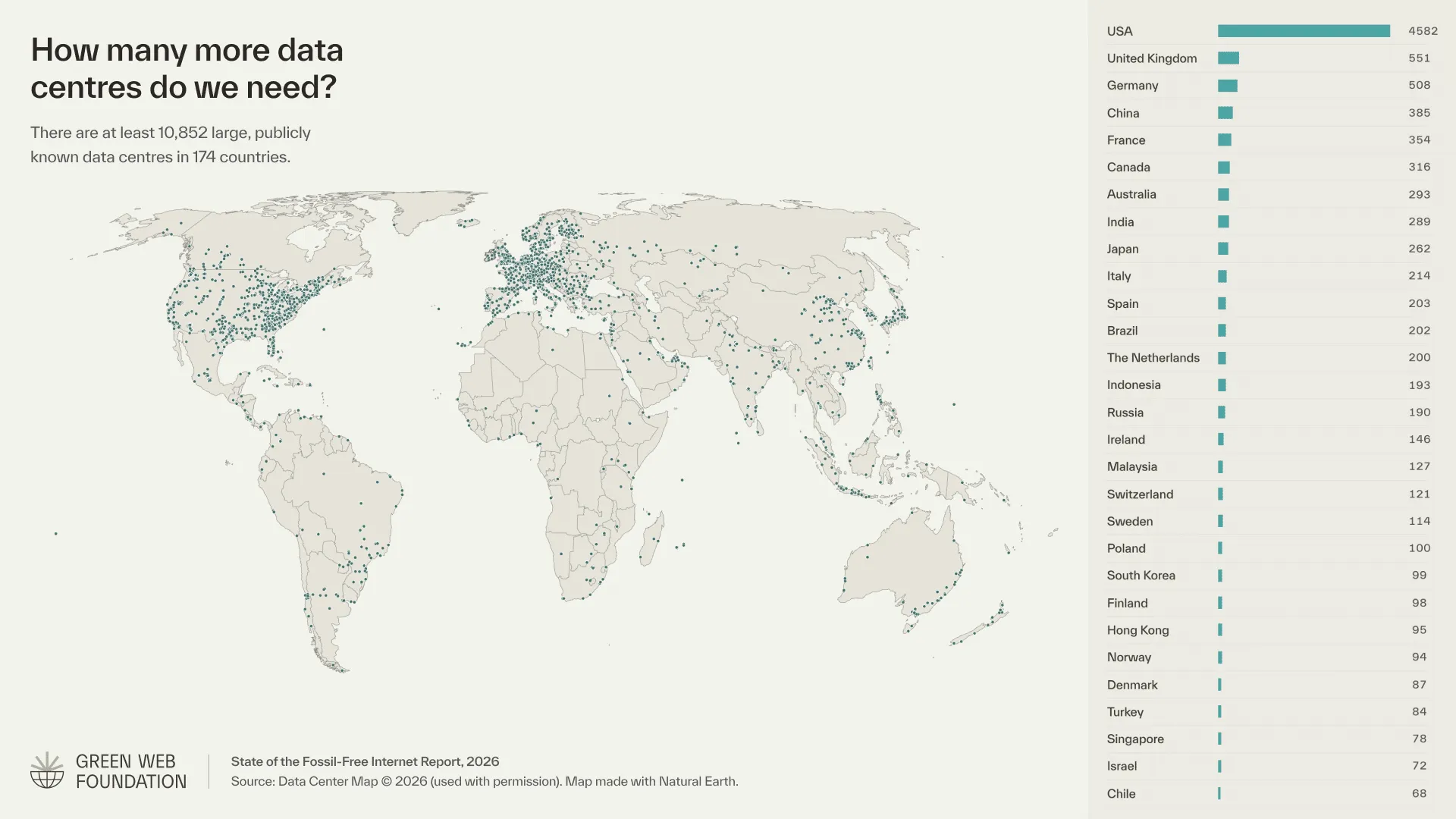
The largest sites, called hyperscale data centres, can cover dozens of football fields and use as much electricity and water as a whole town or city. Their number has tripled over the past seven years, and global operational capacity could double again in the next three. Just three companies, Amazon, Microsoft and Google, control around 58% of today’s global hyperscale capacity.
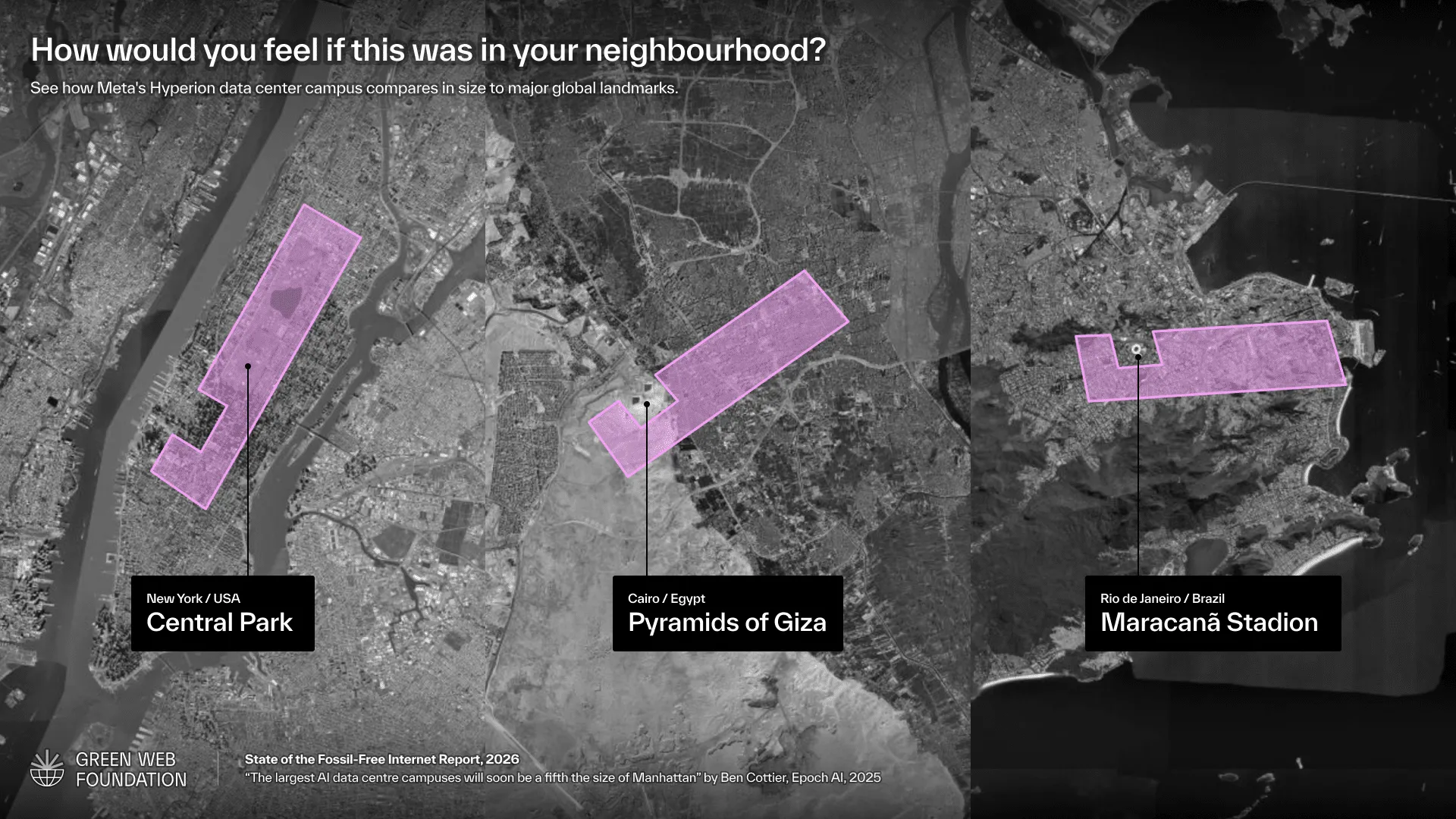
The energy demand is reshaping local grids. More than half of the expected growth in US energy demand is coming from data centres. In Europe they currently use an estimated 2% of total electricity, which could rise to 5% by 2030. When utility companies cannot keep up, operators often build their own fossil-fuelled generators and power plants. Meta’s Hyperion site in Louisiana, soon to be the world’s largest data centre, will be supported by three new gas plants and could use close to as much power as the city of Los Angeles.
The harm reaches local communities
People who live and work near these sites carry much of the cost. Gas turbines and diesel generators release toxic emissions linked to higher rates of asthma, heart disease and cancer. There are documented cases of water drying up in drought-affected regions, rising electricity bills, and promised jobs that never arrive. Much of this happens with limited public transparency over the deals and subsidies struck with local governments.
In the US, the carbon intensity of data centres was 48% higher than the national average, and US greenhouse gas emissions rose by 2.4% in 2025, the first increase in two years. People polled in Europe say they do not want more data centres if those sites are powered by fossil fuels, and in the US, the more people learn about data centres, the more negatively they view them.
Why fossil fuels still dominate
The internet does not need fossil fuels to run. Around 41% of the world’s electricity already comes from renewable sources, and the entire infrastructure could run on green energy at broadly comparable cost. The reason it does not comes down partly to a close relationship between the tech industry and the fossil fuel industry, where both extract large profits and both rank among the most valuable companies in the world.
Google, Amazon and Microsoft have each set carbon targets, net-zero by 2030 for Google, 2040 for Amazon, and carbon negative by 2030 for Microsoft. In reality their fossil fuel emissions are rising sharply.
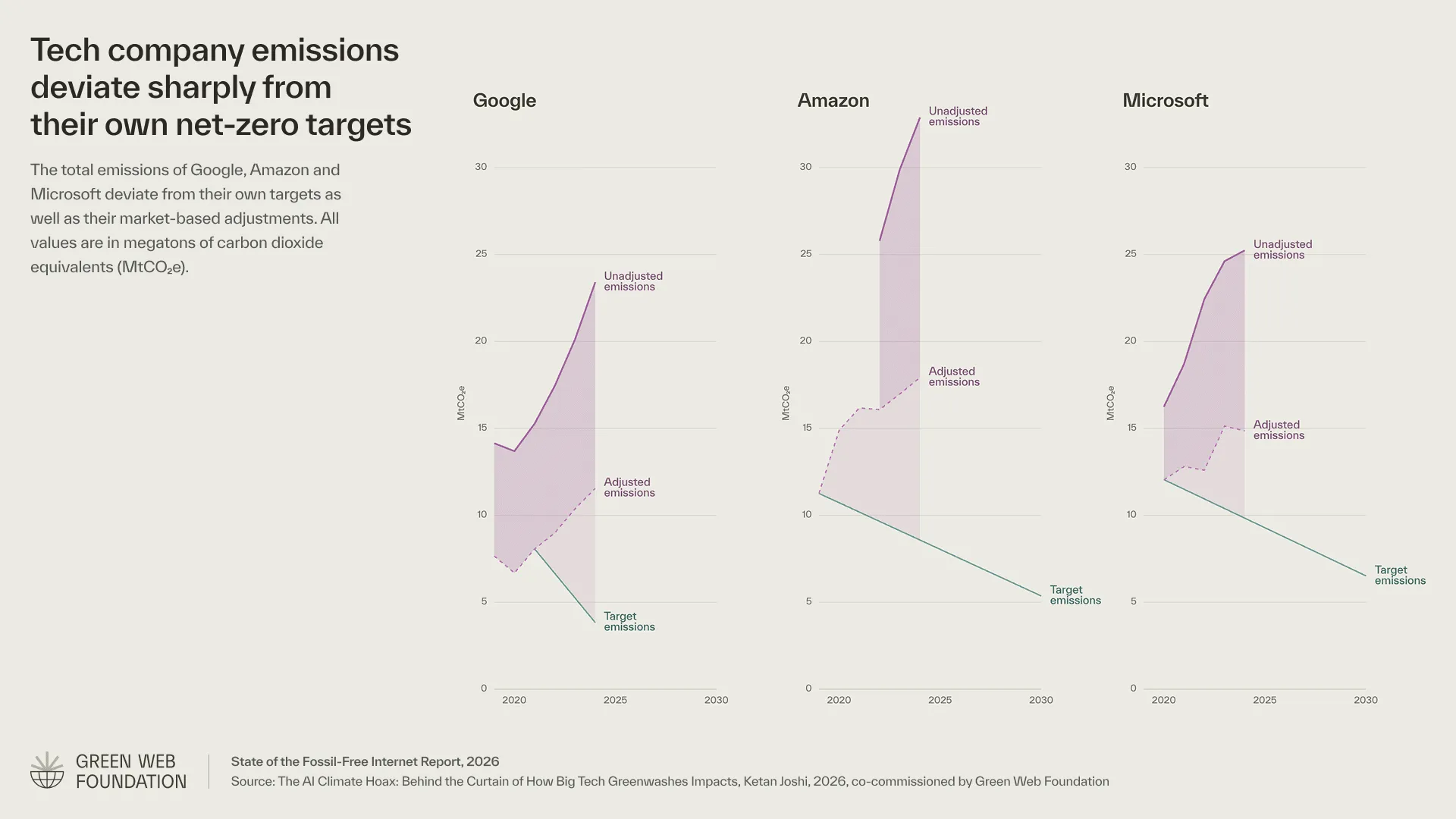
All three claim to cancel out grid emissions by buying unbundled renewable energy certificates, but this is a shortcut for counting energy as green and does not actually displace fossil fuels. Microsoft, for example, states that it matches its electricity use in Ireland to 100% renewable energy, while also holding a permit to run gas generators at a data centre there for up to eight hours a day.
None of the three publishes energy use in a format that makes it easy to monitor or compare what they use in specific regions.
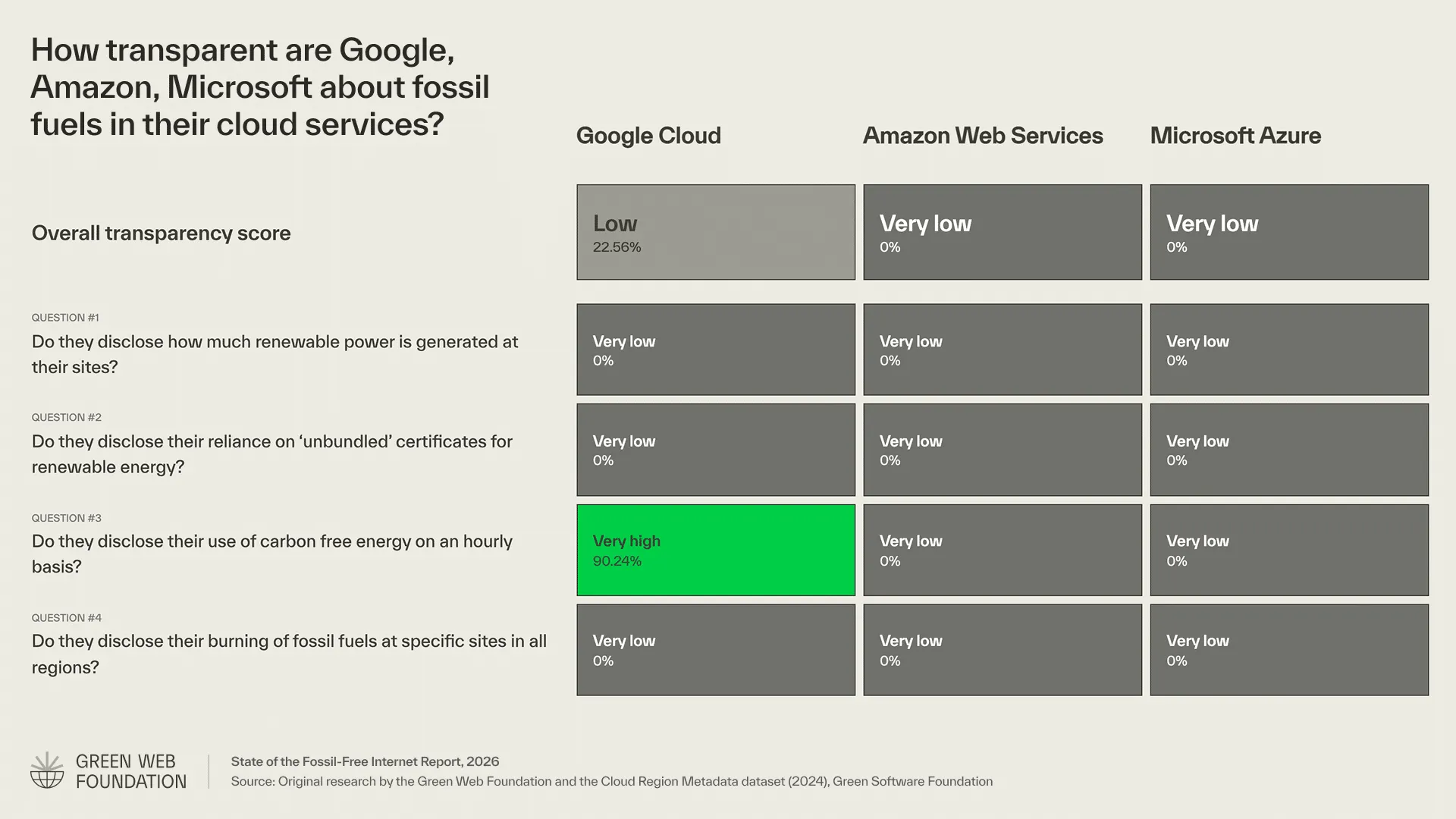
This lack of transparency is part of what makes independent measurement so valuable.
Three pathways to a fossil-free internet
The report sets out three connected pathways, and a fossil-free internet is only possible if we work across all of them.
- Reduce energy demand and keep the internet within planetary boundaries. For technologists, that means not defaulting to the largest generative AI models, since traditional AI and fine-tuned models can use far less energy, and refusing AI altogether where it is not truly needed. The report frames this as a question not just of efficiency but of sufficiency.
- Green the energy supply and cut ties with fossil fuels. Tech companies often claim to use green energy without being independently audited, so the report points to more meaningful ways of buying clean energy and to carbon accounting standards that account for when and where energy is actually produced.
- Democratise technology and move away from the dominance of a handful of companies. This includes building carbon budgets into technical decisions alongside monetary ones, using open source tools such as CO2.js to measure emissions, and supporting alternative ownership models.
Where Kanoppi fits
The thread running through the whole report is that you cannot manage what you cannot measure, and that the companies running the internet’s infrastructure are choosing not to be measured clearly.
Measuring the carbon footprint of a website is a practical response to exactly that gap. It gives website owners a concrete number, shows where hosting and energy choices make a difference, and supports the case for moving to verified green hosts.
Why not start measuring your website’s carbon footprint?
Before you improve your website’s performance, start by measuring the carbon footprint – then you can report on the carbon footprint savings as you speed up your site.
Use our Kanoppi carbon footprint plugin. This intuitive tool provides measurements and insights about your WordPress website’s carbon footprint and helpful recommendations for reducing it.
You can read the full report at fossilfree.greenweb.org/2026, watch the recording of the public briefing through the Green Web Foundation, and download the data visualisations directly from the report site.


Ready to get started with Kanoppi?
Our innovative WordPress plugin is in private beta testing and launching soon. If you are interested, please request a demo and join our waiting list.